Contents
- 1. Onboarding & Risk Mitigation: Bypassing Regional Rest
- 2. Technical Testing: Dual-Device Setup & The Thrill of
- 3. Crypto Tracking & The Psychological Shift: From FOMO
- 4. Policy Enforcement & The End of the Line
- 5. Hard System Evidence
- Client-Side App Status
- Official Backend Suspension Notice
- 6. Conclusion: Physical Telecom Costs Are Unforgiving
During the peak of the Decentralized Physical Infrastructure Networks (DePIN) movement, Helium Mobile created a major buzz across the wireless telecom and crypto communities with its viral $0 eSIM (Zero Plan). Powered by T-Mobile’s underlying national cellular coverage, token-based mapping incentives, and a decentralized hotspot architecture, the service was widely praised as a potential “killer app” designed to disrupt traditional carrier models.
As a long-time radio and telecommunications observer, I tracked and tested the entire lifecycle of Helium Mobile firsthand — from its early technical triumphs to its tightening automated risk controls, and ultimately, complete account cancellation.
Here is a comprehensive breakdown of that journey, blending field deployments, emotional shifts, crypto-economic observations, and real-world system enforcement.
1. Onboarding & Risk Mitigation: Bypassing Regional Restrictions
From day one, Helium Mobile established aggressive anti-fraud filters to deter foreign or non-compliant registrations. The system strictly enforced US-localized IP checks, required US-issued payment cards, and performed deep billing address verification.
Upon receiving an email recommendation from a trusted friend in the United States, I decided to conduct a field test. To understand the completeness of their risk control mechanisms, a trusted friend in the US kindly provided a verifiable residential address for the compliance checks, which allowed the research to proceed. For payment verification, I used a single-use disposable virtual card rather than any primary banking method, ensuring my core financial credentials were never exposed to the platform. Combined with a clean residential network environment, this research setup cleared backend verification checks, allowing me to activate and provision a native US eSIM for observational purposes.
2. Technical Testing: Dual-Device Setup & The Thrill of Exploration
Once the eSIM was provisioned, I conducted a series of hardware and network reliability tests from abroad:
- Hardware Stack: Deployed on a US-spec iPhone SE (2nd Gen) alongside an iPhone 16 for dual-device verification.
- Network Routing: To maintain active line status outside the US, I leveraged cellular data from a local SIM to establish a Wi-Fi Calling over Cellular tunnel.
- Real-World Performance: Voice calls and SMS verification codes routed seamlessly with crystal-clear quality and zero international roaming fees.
For any hardware and radio enthusiast, achieving this level of cross-border connectivity was an absolute technical thrill. However, while enjoying the tinkering process, I maintained a strict line of defense: I intentionally refused to link primary banking methods or sensitive identity credentials to the platform, remaining inherently cautious of Web3 operations.
3. Crypto Tracking & The Psychological Shift: From FOMO to Relief
Beyond cellular connectivity, the MOBILE token economics behind Helium were a central focus for market watchers.
I closely tracked the MOBILE token across major cryptocurrency exchanges — maintaining watchlist alerts on platforms like Coinbase, Binance, Kraken, and Gate.io. The ecosystem reached a high-profile milestone when Andrew Yang, former US presidential candidate and founder of Noble Mobile, made waves with the acquisition/partnership involving Helium Mobile’s consumer wireless business.
Captivated by this momentum, I experienced a strong sense of FOMO (Fear Of Missing Out) and was genuinely eager to purchase and accumulate MOBILE tokens. However, strict regional compliance policies, KYC barriers, and payment gateway restrictions prevented me from completing the transaction. At the time, this compliance wall felt frustrating.
Shortly thereafter, MOBILE token prices experienced a sharp, sustained collapse, while the platform simultaneously tightened user controls due to overwhelming physical infrastructure costs.
What initially felt like a disappointing obstacle suddenly turned into an immense sense of relief. Escaping severe financial devaluation reinforced a profound realization: technical tinkering brings immense joy, but when facing market hype and financial assets, remaining rational and keeping capital safe must always take precedence over speculation.
4. Policy Enforcement & The End of the Line
As token inflation failed to offset physical network settlement expenses, Helium Mobile faced severe margin pressures from its underlying host carrier (T-Mobile). In response, the platform rolled out aggressive enforcement mechanisms, including mandatory physical GPS localization and US-cell-tower usage requirements.
For accounts operating outside these parameters, backend automated bots initiated systematic account cleanups:
- Billing & Compliance Triggers: Failed card re-authorization or missing US tower signals instantly flagged the account.
- Day 3 — Automated Suspension: Unpaid or non-compliant accounts were placed on immediate
Suspendedstatus, cutting off all voice, data, and SMS services. - The 59-Day Grace Period & Termination: While support representatives confirmed a 59-day window to rectify billing, unfulfilled accounts faced complete termination and phone number recycling.
5. Hard System Evidence
Below is the verified system timeline documenting the transition from active service to permanent cancellation:
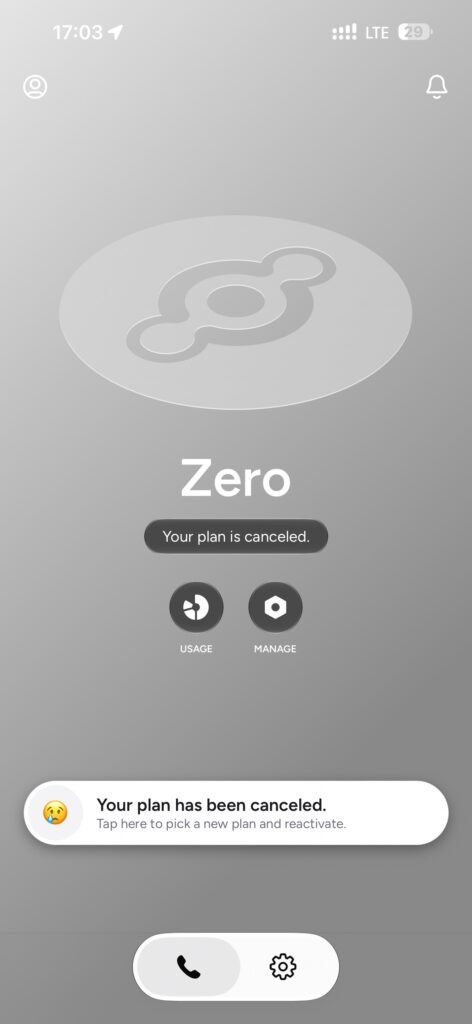
Client-Side App Status
After hitting the automated cancellation threshold, the Helium Mobile client app locked out active controls, displaying the final termination status:
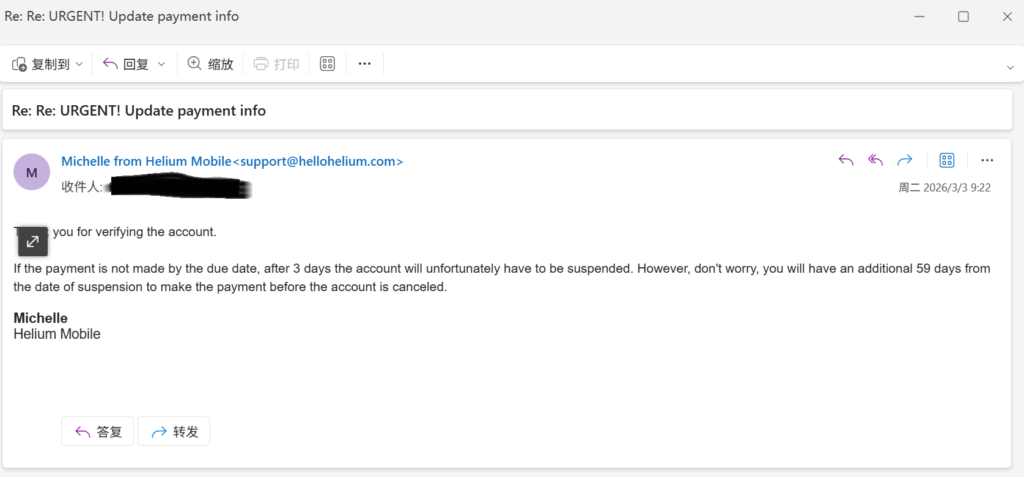
Official Backend Suspension Notice
Simultaneously, the backend billing system dispatched an official enforcement notice from accounts@a.hellohelium.com, explicitly warning of line termination within 3 days:
![Official Helium Mobile suspension notification email titled '[Action Required] Your Helium Mobile Account has been Suspended' — recipient blacked out](https://bg7bag.com/wp-content/uploads/2026/10/6e43968ecae6e8403f67b6375e9591d36f35a925673f8b65d1bbd085e229afed-1024x708.png)
6. Conclusion: Physical Telecom Costs Are Unforgiving
The trajectory of Helium Mobile — from an open $0 promotional feast to automated account purges — serves as an invaluable case study for telecom and Web3 analysts:
- Physical Infrastructure Costs Cannot Be Ignored: Regardless of how tokenomics are packaged, an MVNO leasing physical spectrum from a tier-1 carrier incurs real dollar-denominated costs. When token incentives fail to cover physical settlement bills, decentralized narratives must bow to financial reality.
- Prioritize Technical Rigor Over Speculation: Hands-on technical exploration is deeply rewarding, but maintaining a pragmatic, risk-averse stance toward speculative crypto assets remains the safest long-term strategy.
This case study is part of the ongoing Telecom & Infrastructure Observatory series on bg7bag.com.
Disclaimer: This is a personal testing record for research and educational purposes only. It does not constitute investment advice or guidance for circumventing any service’s compliance mechanisms.
☕ 请作者喝杯咖啡 / Buy me a coffee
如果本站对你有帮助,欢迎赞赏支持,谢谢!
If this site helped you, tips are warmly appreciated.

Ko-fi 赞赏 / Ko-fi