Contents
- What Is a Callsign Prefix in Amateur Radio?
- Entering a Callsign
- Walkthrough: Looking Up BG7BAG
- How to Read the Result
- When to Use It: DXing, Contest Logging, and Shortwave Listen
- Limitations
- Browsing the Full Table
- Frequently Asked Questions
- Related Tools
- Disclaimer
- 业余无线电里,什么是呼号前缀?
- 输入呼号
- 实操演示:查 BG7BAG
- 怎么看懂查询结果
- 什么时候用得上:DX 通联、竞赛日志、短波收听
- 局限性
- 翻看完整对照表
- 常见问题
- 相关工具
- 免责声明
You heard a callsign on the air — or spotted one in a log — and you want to know which country it belongs to. The Callsign Prefix Lookup answers that in seconds: type any amateur radio callsign and it matches the prefix against the official ITU allocation table, showing you the country or region. It is free, needs no sign-up, and works for ham radio operators, shortwave listeners, and anyone curious about a callsign they just came across.
👉 Try the Callsign Prefix Lookup
Looking for the other utilities? Browse all tools on the Toolbox hub.
What Is a Callsign Prefix in Amateur Radio?
Every amateur radio callsign starts with a prefix — the first one to three characters — assigned to a country or territory by the International Telecommunication Union (ITU). The prefix is what tells you that callsigns beginning with JA belong to Japan, or that callsigns beginning with W belong to the United States. Read more on how ITU prefixes work.
Entering a Callsign
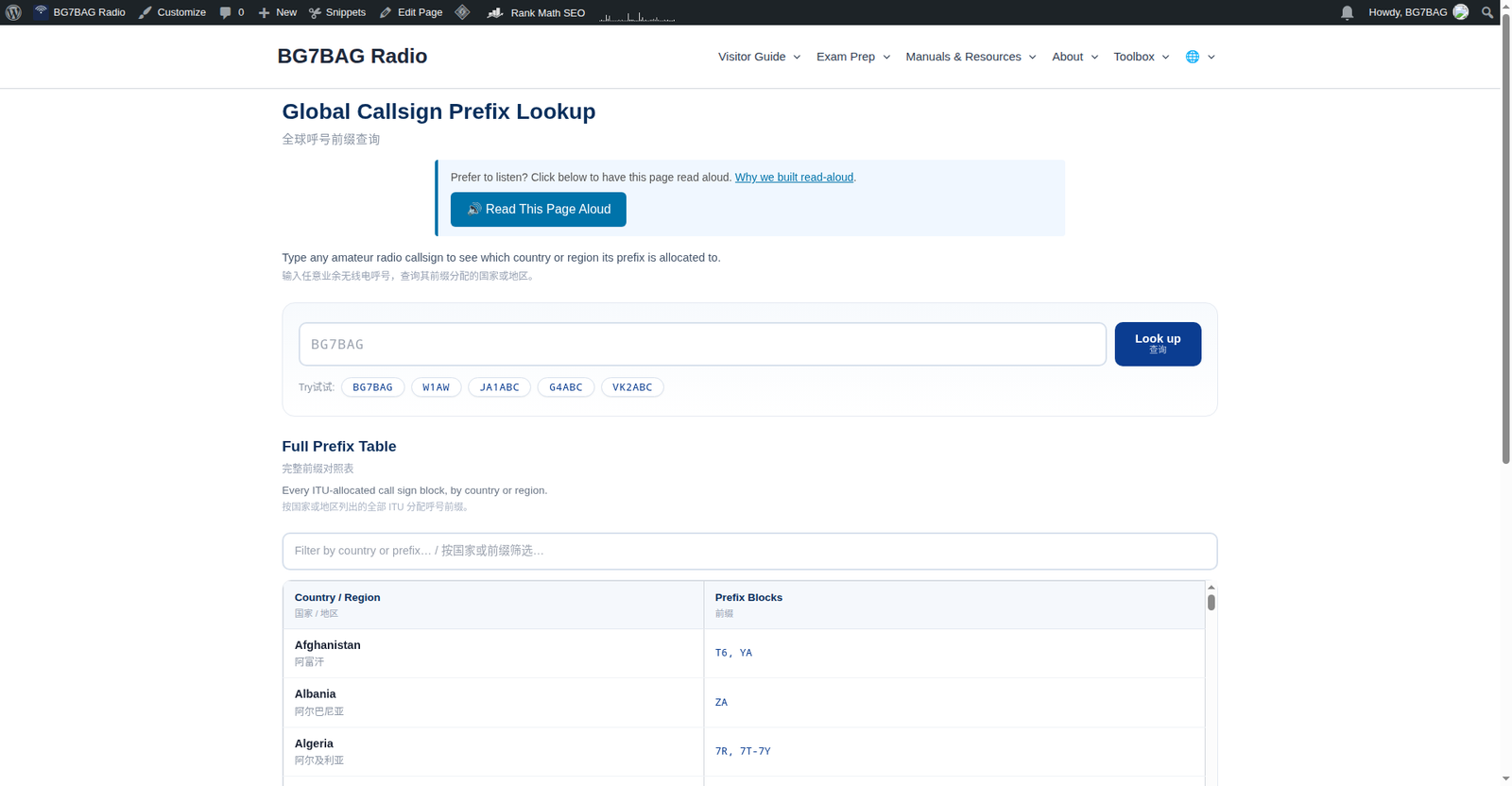
The tool has one input field, with the placeholder text BG7BAG. Type any callsign and press Enter, or click the Look up button. Input is converted to uppercase automatically, so bg7bag works the same as BG7BAG.
Below the field are five example chips — BG7BAG, W1AW, JA1ABC, G4ABC, VK2ABC. Tapping one fills the field and runs the lookup immediately, which is the fastest way to see how the tool responds.
Two details worth knowing: if a callsign carries a portable suffix such as /P or /M, the tool uses the part before the slash. And matching always tries the longest stem first — four characters, then three, then two — so a longer, more specific prefix wins over a shorter one.
Walkthrough: Looking Up BG7BAG
- Type
BG7BAGinto the field (or tap the BG7BAG chip). - Press Enter or click Look up.
- The result card appears: 中国 / China, with the line
Prefix BG → allocated blocks: B, XS, 3H-3U. - Underneath, in smaller text: *”ITU allocation — not a license check.”*
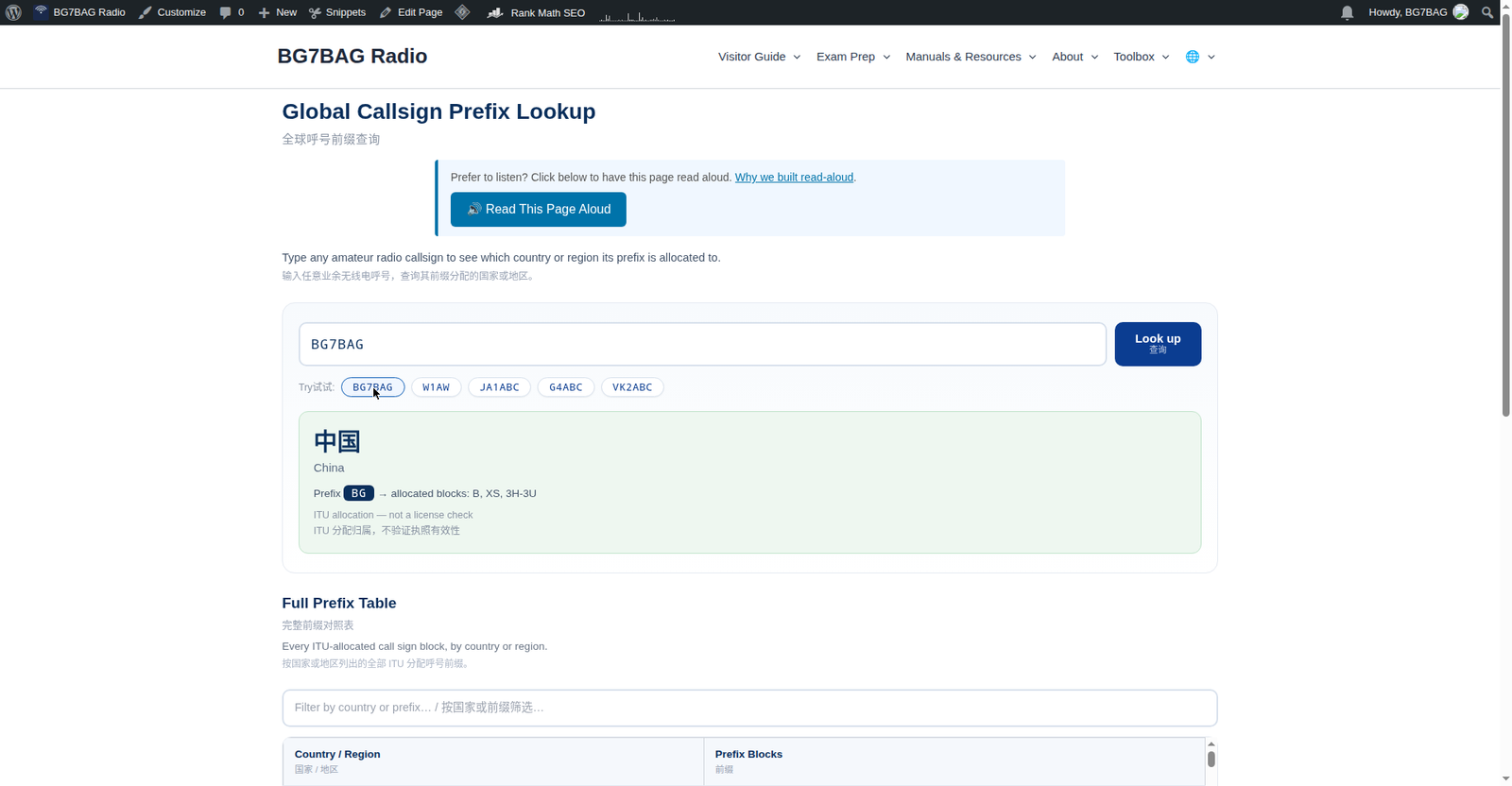
That is the whole workflow. Most lookups take less than a second.
How to Read the Result
- Country name — shown in Chinese first, with the English name below it.
- Prefix stem — the
BGinPrefix BGis the part of your callsign the tool actually matched. Because longest-match wins, a callsign like HB0XYZ resolves to Liechtenstein (HB0), not Switzerland (HB). - Allocated blocks — the full set of prefixes assigned to that country. A single letter like
Bcovers every callsign starting with B;XScovers XS-prefixed callsigns; a range like3H-3Ucovers every two-character combination from 3H through 3U. - “Not a license check” — the small line under every result is the most important one: a prefix match tells you the allocation, not whether the station is licensed or operating legally.
- Shared prefixes — a few prefixes are split between two countries.
SSis the notable one: SSA–SSM belongs to Egypt, SSN–STZ to Sudan. When you look up an SS callsign, the tool shows both countries and points you to the table to sort it out.
When to Use It: DXing, Contest Logging, and Shortwave Listening
- Chasing DX on HF. A rare prefix pops up on the band — look it up before you call, so you know which country you are working and whether it counts as a new one.
- Contest logging. Verify the country multiplier on a callsign before you log the QSO; a wrong country in the log is a lost multiplier.
- Shortwave listening. Heard an unfamiliar station ID? The lookup identifies the country behind it, whether it is an amateur station or another service using an ITU-format callsign.
- QSL cards. Confirm the DX entity behind a callsign before you fill out and send a card — especially for stations operating portable from a different country than their home prefix suggests.
Limitations
- Allocation is not verification. A prefix match never proves a callsign is valid, licensed, or currently on the air. It only shows which country the prefix is assigned to.
- Unofficial prefixes are not covered. Some prefixes in real-world use — S0 (Western Sahara) and 1A0 (Sovereign Military Order of Malta) are the well-known examples — were never allocated by the ITU. Looking one up returns “Not found.”
- Data snapshot. The table is built from ITU call sign series allocations via Wikipedia, retrieved October 2026. Allocations change rarely, but they can change.
- Special cases are noted on the tool page. HB0 is used by Liechtenstein (distinct from Switzerland’s HB); BM, BV, and similar B-block prefixes are used by Taiwan; VR is Hong Kong, XX is Macao, and 4U is the United Nations.
Browsing the Full Table
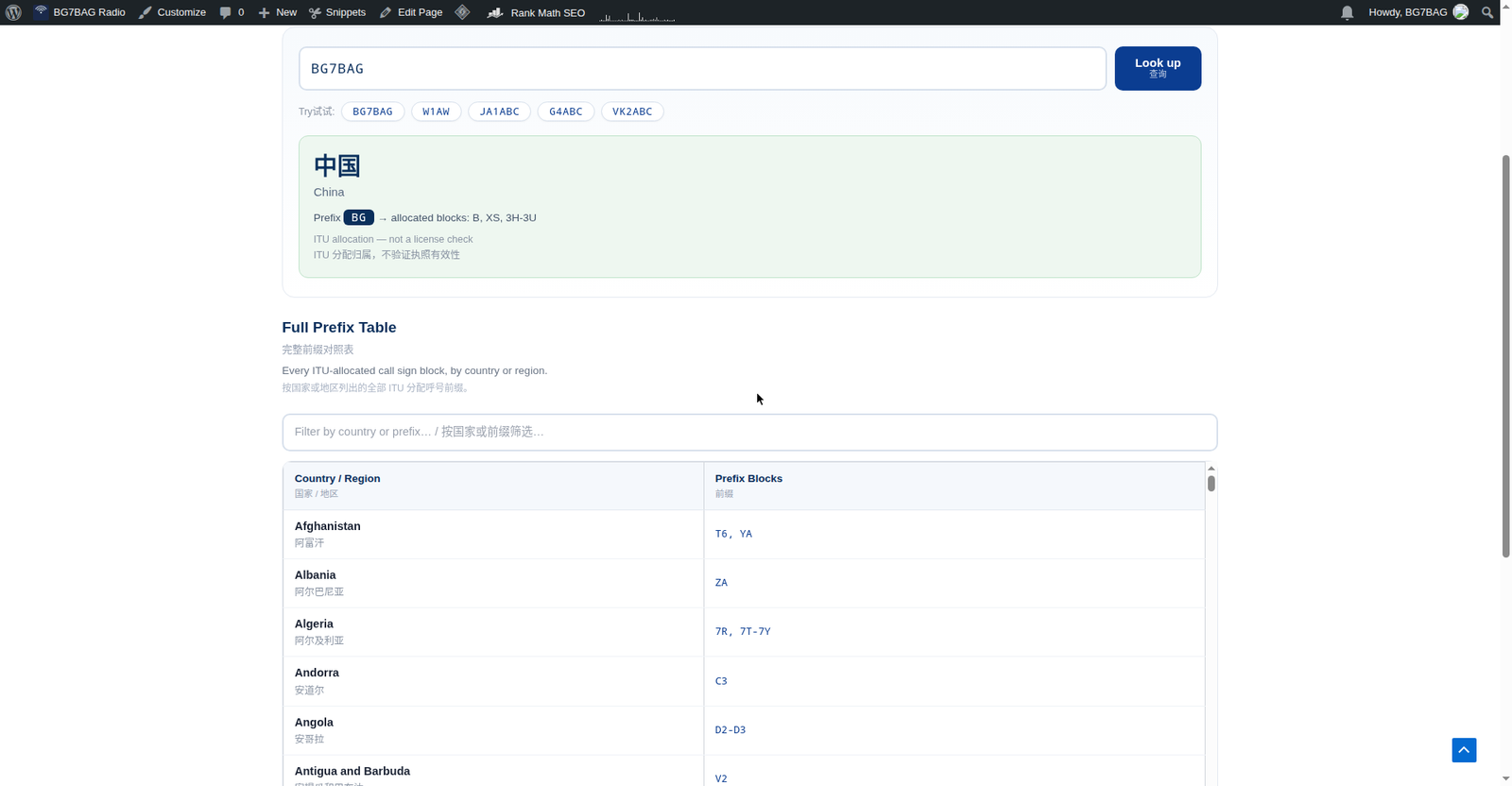
Below the lookup sits the complete allocation table — 201 entries, one per country or region. The filter box at the top (“Filter by country or prefix…”) searches as you type: enter a country name in English or Chinese, or a prefix such as JA, and the table narrows instantly. The count line updates to show how many entries match. This is the fastest way to answer “which prefixes does country X hold?” without typing a full callsign.
Frequently Asked Questions
Does this tool verify that a ham radio callsign is valid or licensed?
No. It shows the ITU allocation for the prefix only — which country the callsign’s leading characters are assigned to. It cannot tell you whether the callsign is issued, current, or legal. For license verification, check the issuing country’s official amateur radio database.
What should I do if my prefix isn’t found?
First check for typos. If the callsign is correct, it may use an unofficial prefix that the ITU never allocated — S0 and 1A0 are the common cases — and those are intentionally not in the table. Remember that portable suffixes after a slash (like /P) are ignored, so a “not found” is about the base callsign.
Where does the prefix data come from, and how current is it?
The 201-entry table is built from ITU call sign series allocations via Wikipedia, retrieved October 2026. ITU allocations are stable — changes are rare — but the table is a snapshot, not a live feed.
Can I search by country instead of typing a callsign?
Yes. Scroll to the full prefix table and use the filter box: type a country name in English or Chinese, or a prefix like VK, and the matching rows appear as you type.
I’m a shortwave listener, not a ham — is this tool useful for me?
Yes. Any station ID in ITU callsign format can be looked up, so when you hear an unfamiliar callsign on the shortwave bands, the tool tells you which country or region it is allocated to.
Related Tools
- Repeater Lookup — once you know the country, find VHF/UHF repeaters there when traveling or operating portable.
- Band Conditions — check live HF conditions before chasing that DX station you just identified.
- Greyline & Sun Times — time your DX around the greyline, when low-band propagation peaks.
Disclaimer
Prefix data comes from public sources (ITU call sign series allocations, via Wikipedia, retrieved October 2026) and is provided for reference and education only. An allocation match does not confirm that a station is licensed, active, or operating legally. Always verify licensing status and operating rules with your national telecommunications authority before transmitting.
👉 Try the Callsign Prefix Lookup · Browse all tools
呼号前缀查询工具使用指南:查出任何业余电台呼号所属的国家
你在空中听到了一个呼号——或在日志里看到一个——想知道它属于哪个国家。呼号前缀查询几秒钟就能给出答案:输入任意业余无线电呼号,工具会将其前缀与 ITU 官方分配表比对,告诉你所属的国家或地区。免费使用,无需注册,适合火腿、短波收听爱好者,以及任何对刚看到的呼号感到好奇的人。
想看看其他工具?去工具箱总览页浏览全部工具。
业余无线电里,什么是呼号前缀?
每个业余无线电呼号都以一个前缀开头——前一到三个字符——由国际电信联盟(ITU)分配给某个国家或地区。前缀决定了呼号的归属:比如以 JA 开头的呼号属于日本,以 W 开头的属于美国。更多背景可看维基百科的 ITU 前缀词条。
输入呼号
工具只有一个输入框,占位文字是 BG7BAG。输入任意呼号后按回车,或点查询按钮。输入会自动转大写,所以 bg7bag 和 BG7BAG 效果一样。
输入框下方有五个示例 chips——BG7BAG、W1AW、JA1ABC、G4ABC、VK2ABC。点一下就会自动填入并立即查询,是最快体验工具的方式。
两点补充:呼号如果带 /P、/M 这类便携后缀,工具只取斜杠前面的部分比对。匹配永远优先最长的前缀——先试四个字符,再试三个、两个——所以更具体的前缀会胜出。
实操演示:查 BG7BAG
- 在输入框输入
BG7BAG(或直接点 BG7BAG chip)。 - 按回车或点查询。
- 结果卡片出现:中国 / China,以及
Prefix BG → allocated blocks: B, XS, 3H-3U。 - 下方小字写着:*”ITU allocation — not a license check.”*(ITU 分配归属,不验证执照有效性)
整个流程就是这样,一次查询通常不到一秒。
怎么看懂查询结果
- 国家名称——中文在上,英文在下。
- 匹配到的前缀——
Prefix BG里的BG是工具实际命中的呼号片段。因为优先最长匹配,像 HB0XYZ 这样的呼号会判给列支敦士登(HB0),而不是瑞士(HB)。 - 分配的前缀段——该国拥有的全部前缀。单个字母如
B表示所有以 B 开头的呼号;XS表示 XS 开头的呼号;3H-3U这样的区间表示从 3H 到 3U 的每一种两字符组合。 - “不验证执照”——每条结果下方的小字是最重要的一句:前缀匹配只说明分配归属,不证明这个电台有执照、合法设台。
- 两国共用的前缀——少数前缀被两个国家分用。典型的是
SS:SSA–SSM 归埃及,SSN–STZ 归苏丹。查到 SS 呼号时,工具会同时列出两国,并提示你对照下表确认。
什么时候用得上:DX 通联、竞赛日志、短波收听
- HF 上追 DX。 波段里冒出一个稀有前缀,先查一下再呼叫——知道对方是哪个国家,也知道算不算新的 DXCC 实体。
- 竞赛记日志。 把 QSO 记进日志之前,先核对呼号对应的国家 multiplier,记错国家就等于丢分。
- 短波收听。 听到不熟悉的电台呼号?查一下就知道它分配给了哪个国家,无论对方是业余电台还是使用 ITU 格式呼号的其他业务电台。
- QSL 卡片。 填写、寄出卡片之前,先确认呼号背后的 DX 实体——对方在异地便携操作时,呼号前缀未必等于操作地,这一步尤其值得做。
局限性
- 分配归属不等于执照验证。 前缀匹配永远不能证明一个呼号真实有效、有执照、正在合法设台,它只说明这段前缀分给了哪个国家。
- 非官方前缀不在表内。 现实中有些前缀 ITU 从未分配——西撒哈拉的 S0、马耳他骑士团的 1A0 是最有名的例子——查它们会返回”未找到”,这是正常的。
- 数据是快照。 全表基于 国际电信联盟呼号序列分配(经维基百科,2026 年 10 月获取)。ITU 分配极少变动,但它毕竟是快照,不是实时数据。
- 特殊情况已在工具页注明。 HB0 为列支敦士登使用(区别于瑞士的 HB);BM、BV 等 B 段前缀为台湾使用;VR=香港、XX=澳门、4U=联合国。
翻看完整对照表
查询框下方是完整的分配对照表——201 个条目,一个国家或地区一行。顶部的筛选框(”Filter by country or prefix… / 按国家或前缀筛选…”)随输随筛:输入英文或中文国家名,或 JA 这样的前缀,表格即时收窄,下方计数会同步更新。想查”某国拥有哪些前缀”,用它比输完整呼号更快。
常见问题
这个工具能验证呼号是否真实有效、有执照吗?
不能。它只显示该前缀的 ITU 分配归属——呼号前几位字符分给了哪个国家。无法告诉你这个呼号是否被签发、是否有效、是否合法。查执照请去各国官方的业余无线电数据库。
查不到我的前缀怎么办?
先检查拼写。如果呼号没错,可能是使用了 ITU 从未分配的非官方前缀——S0、1A0 是常见情况——这类前缀本来就不在表里。另外斜杠后的便携后缀(如 /P)会被忽略,”未找到”指的是斜杠前的主体呼号。
前缀数据从哪来,有多新?
全表 201 条目基于 ITU 呼号序列分配(经维基百科,2026 年 10 月获取)。ITU 分配非常稳定、极少变动,但它仍是快照,不是实时同步的数据源。
不想输呼号,能直接按国家查吗?
可以。翻到下方的完整前缀表,用筛选框输入英文或中文国家名,或 VK 这样的前缀,匹配的行会即时出现。
我是短波收听爱好者,不是火腿,这个工具对我有用吗?
有用。任何 ITU 格式的电台呼号都能查——在短波波段听到不熟悉的呼号时,工具会告诉你它分配给了哪个国家或地区。
相关工具
- 中继查询——知道了国家,旅行或便携操作时顺手查当地的 VHF/UHF 中继。
- 波段传播条件——追刚查到的 DX 电台之前,先看 HF 波段传播开没开。
- 晨昏线与日出日落——掐着晨昏线前后操作,低波段 DX 传播最好。
免责声明
前缀数据来自公开来源(ITU 呼号序列分配,经维基百科,2026 年 10 月获取),仅供参考与学习。分配归属匹配不代表该电台有执照、正在工作或合法设台。发射操作前,请务必向本国电信主管部门核实执照状态与操作规定。
☕ 请作者喝杯咖啡 / Buy me a coffee
如果本站对你有帮助,欢迎赞赏支持,谢谢!
If this site helped you, tips are warmly appreciated.
Ko-fi 赞赏 / Ko-fi